[9 minute read]
TL;DR: A recent conversation highlighted the power of creative expression to support mental health, dignity, and connection for adults with disabilities or for those who see themselves on the margins. Experiences shared through the Images of God project and at Shalem’s RE-create Outreach Studio confirm how art can be a source of transformation, hope and belonging. Art is a conduit for accessible and humanizing pathways to mental health, well-being and spiritual expression. In the Images of God project, the participants’ responses and photos capture the theological heart of faith and their relationships with God. Art opens up spaces, enables us to see and understand through someone else’s eyes and speaks in ways that words cannot always capture, allowing us to we create our way back to one another and into community.
Jump to: Images of God Project |Art and Mental Health
Earlier this year I had the opportunity to connect virtually with Keith Dow from Karis Disability Services. We had such a delightful conversation as we recognized common elements in the work that we do.
Keith is an ordained pastor who supports the spiritual and mental well-being of people with intellectual and/or developmental disabilities. I am the artistic director and founder of RE-create Outreach Art Studio which supports the well-being of youth who often find themselves on the fringes of society.
It was a conversation between a theologian with an interest in psychology who cares deeply about nurturing the spiritual and wholistic well-being of a person, and an artist, art therapist, and psychotherapist whose work is rooted in spirituality and faith. As we spoke, we shared our understanding of how creative expression supports mental health, dignity, and connection for adults with disabilities and for those who see themselves on the margins.
The Connecting Power of Art
Woven throughout our conversation was the understanding and experience that art and the act of art-making transcends barriers, boundaries, differences and moments when there are no words. As Keith noted, “There’s a kind of common heart to connect people through the arts.”
It was clear that we both experience the power of art in our work. Art is healing. Art is expansive. Art is an equalizer. It is transformative. Art nourishes hope. In the act of art-making, one is able to see a different perspective, see an alternative way, to imagine possibilities. And it is in that imagining that one explores what it takes and looks like to transform.
It was a treat to spend time with Keith and learn about some of the initiatives he is involved in. Keith role is to serve as the manager of organizational spiritual life with Karis Disability Services. The seeds for our conversation were planted at the Mental Health Summit that Shalem hosted in May of 2025 where Keith and one of the participants of the Images of God Project shared lived experiences and outcomes from this Ontario-wide project that Karis Disability Services facilitated.
The Images of God project
Keith shared that he has come to recognize that “research, like spirituality itself, in many ways, especially religion, tend to exclude people with intellectual and developmental disabilities.” This motivated Keith to have ongoing conversations with Christians with intellectual and developmental disabilities about how they understand and represent God and divine realities.
Out of these ongoing conversations was born the Images of God project, funded by the Templeton Foundation. The Images of God project was based on Photovoice methodology and invited Christians in Ontario with an intellectual and/or developmental disability to tackle and explore how they understand and represent God through the arts.
The people participating in this project were asked to take photos of what reminds them of God, or makes them think of God. Keith reiterated that his foundation and training is in theology and he is new to the psychological research world and as such a primary objective of this project was that those who participated would find it meaningful and accessible, and they would be enabled to express themselves.
Keith discovered that art, the act of art making and creating, was what brought these conversations alive and imbued them with richness and nuances that words alone could not capture. Keith spoke about the power of the art to capture and speak to people’s understanding and experience of the divine, of God, in ways that were clear and profound, capturing deep theological concepts.
He shared how one participant, when talking about their photos, commented that they see God in making art, and that their involvement in this project brought to the fore something that they otherwise had not quite articulated, that “God is in everything, …. and that in art we truly get to express what we see God do as well.”
Keith also referenced another participant who had captured their sense of God in pictures of creation and nature and was left wondering why did God create all this? True to the Photovoice format the question was given back to the participant to wonder about. The participant’s response was, “because he wants people to enjoy life.” Keith notes that this response and his photos capture the theological heart of faith and relationship with God, namely, that God delights in us, and desires that we know and live out of that delight.
The ways the different participants in the Images of God project captured their experience and understanding of God was varied, profound and poignantly conveyed. Keith noted that one of the learnings from the Images of God project “is just how we need to expand the ways we look at people to communicate who God is and what God is all about.”
Keith spoke of the incredible ways that art was a conduit for accessible and humanizing pathways to mental health and well-being. The presentation described experiences that are similar to the work that takes place at Shalem’s RE-create Outreach Art Studio.
The Power of Art at RE-create Outreach Art Studio
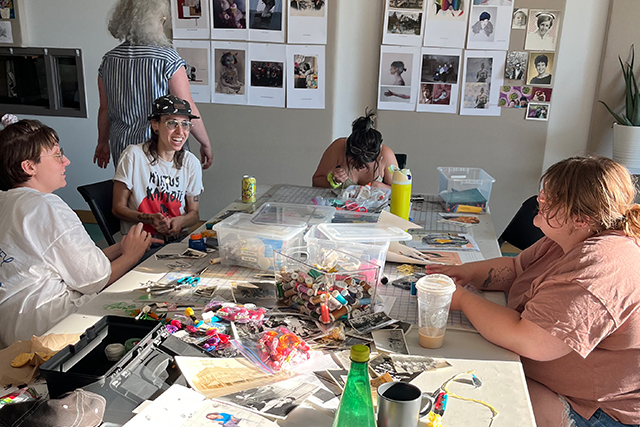
RE-create Outreach Art Studio is a drop-in open arts studio for at-risk youth 16-24 to come and create. Established in 2003, it is now located at the Gasworks, a hub of creativity in downtown Hamilton. RE-create offers open studio time three times a week, as well as community workshops, outreach walks and various opportunities for youth to step into leadership roles. It is a place where youth can begin to reconnect to themselves, others, and their community through the creative arts, while gaining valuable life skills. RE-create seeks to provide a non-judgmental space for youth who find themselves on the margins of society.
At RE-create, we experience the coming together around the art table, creating and making art, and we see how building connections creates community. As Marie Sinclair, one of RE-create’s studio facilitator said, “RE-create is a drop-in studio, an open shifting space where art becomes a way to connect with ourselves and each other. The artwork isn’t tied to one medium or outcome or product, but to the act of showing up. In a world that often asks for things to be finished or “good”, RE-create makes room for things to be in progress – for trying, pausing, and starting again.”
RE-create is about art-making and it is about more than art making. RE-create believes that the act of creating is not only a form of self-expression, but that is also provides the potential for imagining new possibilities and strengthens hope and resiliency. RE-create was born out of a simple but powerful belief: that creativity, safety and belonging can change the trajectory of a young person’s life.
Art and Mental Health
What stood out in my conversation with Keith was that we both see the impact of society’s tendency to sort people into those who contribute (givers) and those who receive; those who have power and those who are viewed as having less. These dichotomies are false and don’t serve anyone well. The fact of the matter is that we all move along the continuum from contributor to recipient.
When we narrowly define people as contributor or receiver, we relegate them to the margins. Instead of encouraging and facilitating growth and nurturing hope, we put in limits that restrict the flow of hopefulness, rather than expanding it, thereby allowing hopelessness to creep in. This restriction fuels hopelessness, that sense that change is not possible, of not being empowered or feeling that you are valued.
Yet as both Keith and I noted, in our respective settings, that kind of simplistic and dualistic thinking doesn’t capture the fluidity that is present as we all move between being a contributor and a recipient. There is a reciprocity to life and living and to faith through action of being able to be both the giver and the receiver. The art lies in the movement back and forth, the dance.
Art Gives Glimpses of Each Other and the Divine
In our conversation we explored how art taps into different aspects of ourselves that we may not always explore or be aware of. A powerful thing that happens through the making and sharing of art is that we witness the other. We are being seen and valued by the other. We are creating community. In so doing we create glimpses of those liminal spaces where we experience the divine. If we can break down barriers and create space that is accessible, then everyone thrives.
Keith used the example of how we hang our child’s art on the refrigerator and how that while it may not be the best art in the world, it “speaks to the nature of belonging and the relationship within which the art was produced.”
It strikes me in talking with Keith that in both of our areas of work, it is through the creative act, the making of art that we are seen and catch glimpses of the ways our Creator sees us. At RE-create, we have a section of the wall set aside as the “art hall of fame,” where youth artists can put up their art for display, as on a refrigerator. The message is that your art matters, you matter; you are a vital part of this community.
In the Images of God project, the participants’ responses and photos capture the theological heart of faith and relationship with God, namely that God delights in us, and desires that we know and live out of that delight. It envisions a community where each of us gathers around the table and are both givers and receivers, where there is a spot on the wall where each of us are invited to hang up our art and to be witnessed by others.
Art extends and keeps drawing the circle larger. It takes the proverbial box that can limit and divide, and transforms it into something that is expansive and inviting. We need to break free of constrictive religious boxes that limit us, and allow God’s love and expansiveness to move freely out, connect us, and gather us together at the table where we all come as those who need to receive and those who have gifts to give.
Gathering around an art table is such an equalizing way to break down barriers, to unite and invite people to connect together as community. Keith noted that so many of us, with or without intellectual or developmental diagnosis, feel like we don’t have a lot to contribute. But as Bruce Herman, in his book, Makers by Nature: Letters from a Master Painter on Faith, Hope, and Art, noted, we are all makers by nature and have things to contribute.
Perhaps we all need to pick up a paintbrush or a camera and so we can capture and convey our understanding of God, faith, self and others through colour, texture, shape, and lines. Keith noted how one of the themes in the photovoice project, ‘belonging to God and one another,’ which includes our human relationships, has deep spirituality connected to it. “All of these things like grief, loss, self-worth, transformation etc. and experiencing God or awe in and through the world around us, as a theologian, I title that every day incarnation.”
Art opens up spaces, enables us to see and understand through someone else’s eyes and speaks in ways that words cannot always capture. In the Images of God project and at RE-create, the art and the making help shift space, expands and opens it, enabling us to connect with ourselves, with each other and the world.
There isn’t one way. Rather we are invited and encouraged to show up, to leave a mark, our mark, as we create our way back to one another and into community.
Betty J.B. Brouwer M.Sc., RP, is a Registered Psychotherapist and Director of Attachment Services at Shalem and the Artistic Director of Shalem’s RE-create Outreach Art Studio.